As industries become smarter, faster, and more connected, the importance of Functional Safety has never been greater. While automation accelerates innovation, it also introduces new risks that must be carefully managed. This is where Functional Safety Experts in India play a critical role. They ensure that electrical, electronic, and software-controlled systems continue to operate safely, even when unexpected failures occur.
From electric vehicles and advanced driver assistance systems (ADAS) and semiconductor technologies, safety has become an essential part of product development. Organizations are increasingly investing in Functional Safety Experts in India to reduce engineering risks, comply with international safety standards, and deliver reliable products to the global market.
Looking for Functional Safety consulting or independent safety assessments?
AutoFuSa helps automotive and semiconductor organizations achieve ISO 26262 compliance through expert consulting, safety analysis, reviews, assessments, and professional training.
AutoFusa
Location : Bengaluru | Coimbatore | united kingdom
Contact us +91 9949499577
Website : https://autofusa.co.in/
Growing Need for Functional Safety Experts in India
Functional Safety is a specialized skills of system engineering that ensures electrical, electronic, and programmable electronic (E/E/PE) systems respond safely whenever faults or abnormal operating conditions occur.
Unlike reliability engineering, which focuses on minimizing failures, Functional Safety assumes that failures are inevitable. The objective is to detect failures, control their impact, and transition the system into a predefined safe state before they can create hazardous situations.
As modern products become increasingly software-driven, Functional Safety has evolved from a regulatory requirement into a core engineering discipline.
Why Functional Safety Is Becoming Critical in India
India is witnessing significant growth across Automotve and several other industries, including:
- Automotive including Electric Vehicles (EVs)
- Industrial Automation and Smart Manufacturing
- Semiconductor Design and Verification
- Rail Transportation
- Aerospace and Defence
- Robotics and Embedded Systems
These industries are rapidly adopting technologies such as Artificial Intelligence (AI), Internet of Things (IoT), autonomous systems, and advanced embedded software. While these innovations improve performance and user experience, they also increase system complexity.
As complexity increases, so does the possibility of failures. This has created a growing demand for Functional Safety Experts in India, who help organizations identify potential hazards early and build systems capable of responding safely to failures.
Did You Know?
Modern vehicles can contain more than 100 Electronic Control Units (ECUs) and millions of lines of software code. Functional Safety ensures these complex systems continue to operate safely even when hardware or software faults occur.
What Do Functional Safety Experts in India Actually Do?
Functional Safety Experts in India are responsible for ensuring that safety-critical products comply with international Functional Safety standards throughout the entire product development lifecycle.
Rather than focusing only on product performance, these professionals identify potential hazards, define safety requirements, perform engineering analyses, verify safety mechanisms, and prepare the evidence required for compliance.
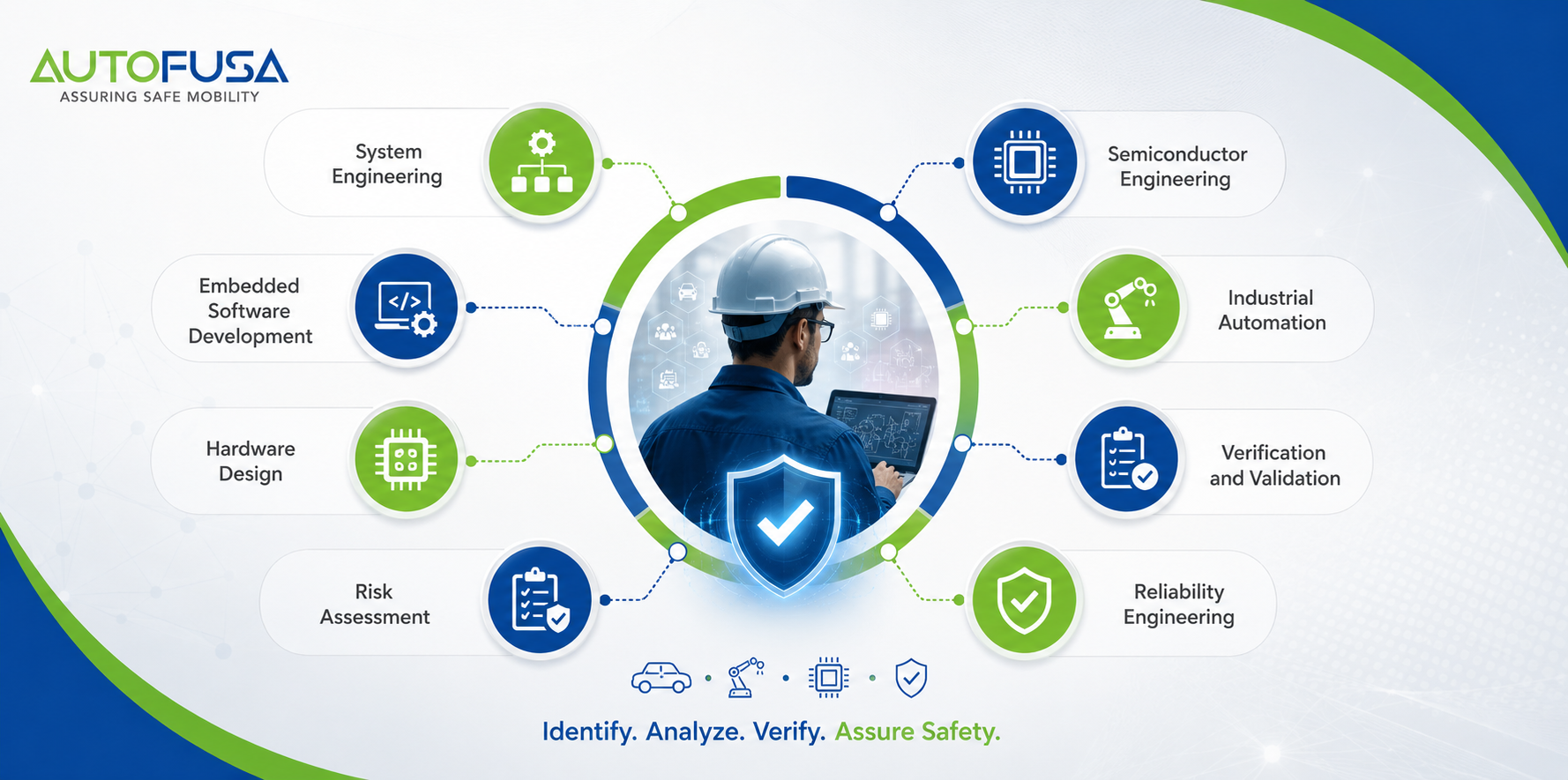
Their expertise spans multiple engineering disciplines, including:
- System Engineering
- Embedded Software Development
- Hardware Design
- Semiconductor Engineering
- Industrial Automation
- Verification and Validation
- Reliability Engineering
- Risk Assessment
Their work helps organizations build products that protect users, equipment, and the environment while meeting stringent international safety requirements.
Identifying Hazards Before They Become Accidents
Every Functional Safety project begins with understanding what could potentially go wrong.
Functional Safety Experts in India perform detailed hazard identification by analysing:
- Operating conditions
- System interactions
- Human-machine interfaces
- Environmental influences
- Equipment failures
- Software faults
- Misuse scenarios
Using structured engineering techniques such as Hazard Analysis and Risk Assessment (HARA), Hazard and Operability Study (HAZOP), and Risk Assessment, engineers evaluate the severity and likelihood of hazards.
Based on these findings, they define Safety Goals that guide the development of safe system architectures.
Developing Safety Concepts and Safety Requirements
Once hazards have been identified, the next responsibility is converting risks into clear engineering requirements.
These requirements form the foundation of the entire development lifecycle and ensure every engineering team works toward a common safety objective.
Typical deliverables include:
- Functional Safety Requirements (FSR)
- Technical Safety Requirements (TSR)
- Safety Goals
- Safe State Definitions
- Fault Detection Requirements
- Diagnostic Coverage Targets
These requirements influence system architecture, hardware development, embedded software implementation, verification activities, and final validation.
📊 Industry Fact
According to the International Organization of Motor Vehicle Manufacturers (OICA), global vehicle electronics continue to increase with every new generation of connected and autonomous vehicles. As electronic complexity grows, Functional Safety has become a mandatory requirement for automotive product development under ISO 26262.
Designing Fault-Tolerant System Architectures
One of the primary responsibilities of Functional Safety Experts in India is designing systems that remain safe even when components fail.
To achieve this, engineers incorporate various fault detection and fault tolerance mechanisms into system architecture.
Common safety mechanisms include:
- Redundant Controllers
- Lockstep Processors
- Watchdog Timers
- Error Correcting Codes (ECC)
- Cyclic Redundancy Check (CRC)
- Safe Communication Protocols
- Built-in Diagnostic Functions
The objective is straightforward:
No single-point fault should directly lead to a hazardous event.
This principle is fundamental to Functional Safety engineering and is widely applied across automotive, semiconductor, industrial automation, and embedded system development.
Performing Safety Analyses
Safety cannot rely on assumptions. It must be demonstrated through systematic engineering analysis.
To validate that a system satisfies its safety objectives, Functional Safety Experts in India perform several industry-recognized analyses.
These include:
Failure Modes and Effects Analysis (FMEA)
Evaluates how individual component failures affect the overall system and identifies actions to reduce associated risks.
Failure Modes, Effects and Diagnostic Analysis (FMEDA)
Measures failure rates, diagnostic coverage, safe failures, and hardware architectural metrics to demonstrate compliance with Functional Safety requirements.
Fault Tree Analysis (FTA)
Identifies combinations of failures that could potentially result in hazardous events and helps engineers implement preventive safety measures.
Dependent Failure Analysis (DFA)
Evaluates cascading failures and common cause failures between interconnected subsystems to ensure independent safety mechanisms remain effective.
These analyses provide objective engineering evidence that the product satisfies Functional Safety requirements before it progresses to verification and validation.
Need support with FMEA, FMEDA, FTA, ISO 26262 implementation, or independent Functional Safety reviews? AutoFuSa’s experienced Functional Safety consultants help organizations accelerate compliance while reducing engineering risk.
Supporting Functional Safety Throughout the Development Lifecycle
Functional Safety is not a one-time activity performed at the beginning or end of a project. It is an engineering process that spans the entire product development lifecycle. Functional Safety Experts in India work closely with cross-functional teams to ensure that every stage of development aligns with the defined safety objectives and complies with applicable standards such as ISO 26262.
From concept development to product release, they collaborate with system architects, hardware engineers, embedded software developers, verification engineers, quality teams, and independent safety assessors to ensure safety is integrated into every engineering decision.
Verifying and Validating Safety Functions
A safety mechanism is only effective if it has been thoroughly verified and validated. One of the key responsibilities of Functional Safety Experts in India is to ensure that every safety requirement is tested and supported by objective evidence before the product reaches production.
Typical verification and validation activities include:
- Requirement Verification
- Hardware Verification
- Software Verification
- Fault Injection Testing
- Integration Testing
- Functional Safety Validation
- Independent Safety Assessments
- Compliance Audits
These activities confirm that the implemented safety mechanisms perform as intended under both normal operating conditions and fault scenarios.
Maintaining Complete Safety Traceability
Traceability is one of the fundamental principles of Functional Safety. Every safety-related activity must be linked throughout the development lifecycle to demonstrate compliance and simplify future audits or product modifications.
Functional Safety Experts in India establish end-to-end traceability by connecting:
- Identified Hazards
- Safety Goals
- Functional Safety Requirements
- Technical Safety Requirements
- System Design
- Test Cases
- Verification Results
- Validation Evidence
Maintaining this traceability ensures that every identified risk has been addressed and that no safety requirement is overlooked during development.
Preparing Functional Safety Compliance Documentation
Comprehensive documentation is essential to demonstrate that Functional Safety activities have been systematically performed. Regulatory bodies, customers, and independent assessors rely on documented evidence to verify compliance with international standards.
Typical Functional Safety deliverables include:
- Safety Plan
- Hazard Analysis Report
- Functional Safety Concept (FSC)
- Technical Safety Concept (TSC)
- Safety Requirements Specification (SRS)
- FMEDA Reports
- Fault Tree Analysis (FTA) Reports
- Verification Reports
- Validation Reports
- Functional Safety Assessment Reports
- Safety Case
Well-structured documentation not only supports compliance but also improves project transparency, knowledge transfer, and long-term product maintenance.
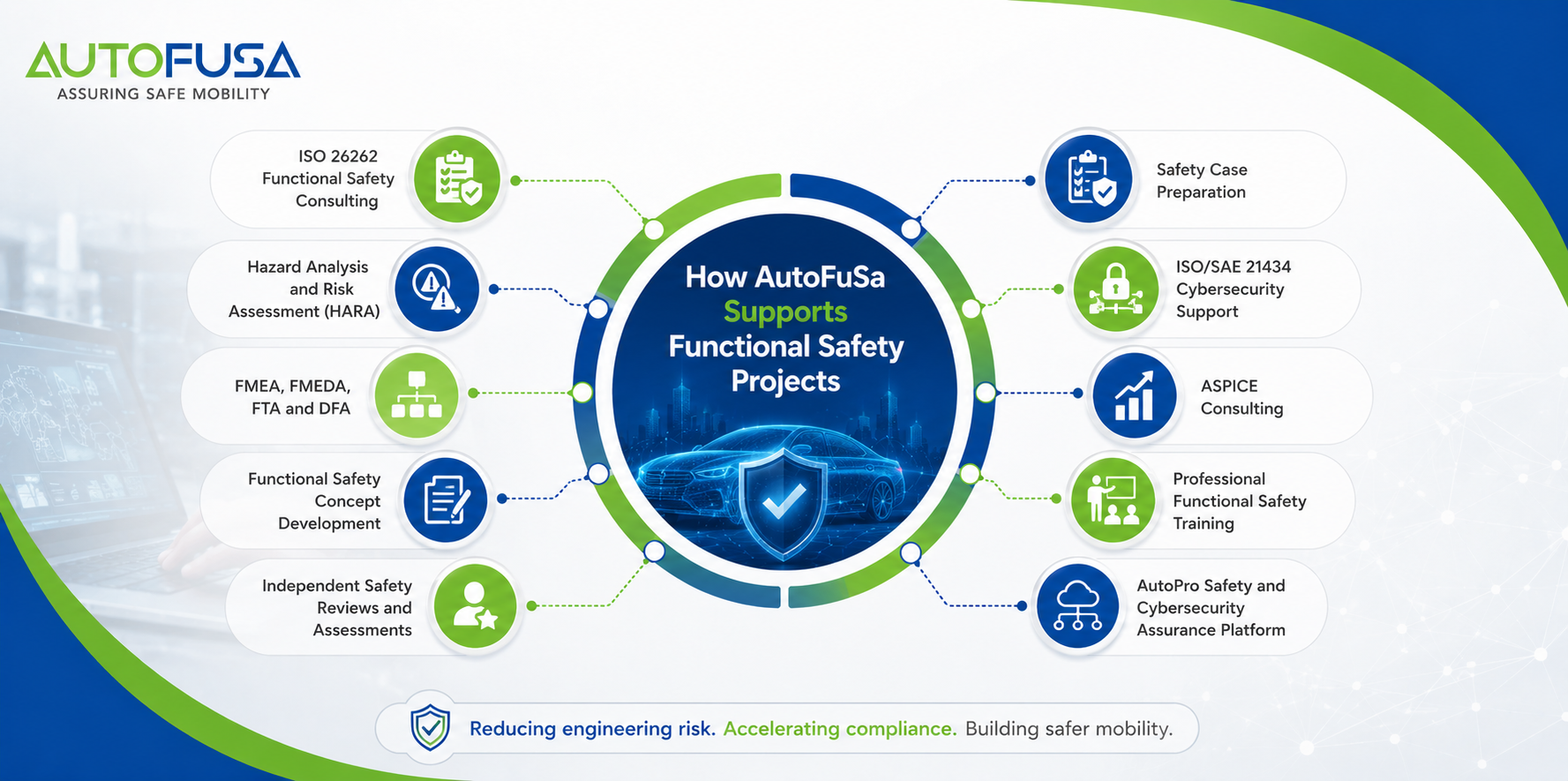
How AutoFuSa Supports Functional Safety Projects
AutoFuSa partners with OEMs, Tier-1 suppliers, semiconductor companies, and automotive software organizations to accelerate Functional Safety implementation and compliance.
Our expertise includes:
- ISO 26262 Functional Safety Consulting
- Hazard Analysis and Risk Assessment (HARA)
- FMEA, FMEDA, FTA and DFA
- Functional Safety Concept Development
- Independent Safety Reviews and Assessments
- Safety Case Preparation
- ISO/SAE 21434 Cybersecurity Support
- ASPICE Consulting
- Professional Functional Safety Training
- AutoPro Safety and Cybersecurity Assurance Platform
Whether you are starting a new safety-critical project or preparing for compliance assessments, AutoFuSa provides the technical expertise needed to reduce engineering risk and streamline the development process.
Need guidance on your next Functional Safety project? Contact AutoFuSa to learn how our consulting services, independent reviews, and training programs can support your engineering and compliance goals.
Frequently Asked Questions (FAQs)
- What do Functional Safety Experts in India do?
Functional Safety Experts in India identify potential hazards, perform risk assessments, define safety requirements, conduct analyses such as FMEA and FMEDA, verify safety mechanisms, and ensure compliance with standards like ISO 26262 throughout the product lifecycle.
- Which industries hire Functional Safety Experts in India?
They are employed across automotive, electric vehicles, semiconductor design, industrial automation, aerospace, rail transportation, medical devices, and embedded software industries.
- What skills are required to become a Functional Safety expert?
Professionals should have knowledge of system engineering, embedded software, hardware design, ISO 26262, HARA, FMEA, FMEDA, FTA, risk assessment, and safety verification techniques.
- Why is Functional Safety important in the automotive industry?
Functional Safety helps ensure that vehicle electronics and software respond safely during faults, reducing the risk of accidents and supporting compliance with international standards such as ISO 26262.
- What is ISO 26262?
ISO 26262 is the international Functional Safety standard for automotive electrical and electronic systems. It defines the processes and requirements needed to develop safe road vehicles.
- What is the difference between Functional Safety and reliability?
Reliability focuses on reducing the likelihood of failures, while Functional Safety ensures that when failures do occur, the system responds safely and prevents hazardous situations.
- How does AutoFuSa help organizations with Functional Safety?
AutoFuSa provides Functional Safety consulting, safety analyses, independent reviews, ISO 26262 implementation support, assessments, training, and the AutoPro platform to help organizations develop safe and compliant products.
- Why is there a growing demand for Functional Safety Experts in India?
The expansion of electric vehicles, autonomous systems, semiconductor technologies, and industrial automation has increased the need for engineers who can develop safety-critical systems that comply with global standards.
As industries continue to embrace intelligent electronics, connected systems, and software-driven technologies, Functional Safety has become a critical engineering discipline. The role of Functional Safety Experts in India extends far beyond compliance—they help organizations build products that are safe, reliable, and ready for global markets.
By identifying hazards, defining safety requirements, performing rigorous safety analyses, verifying safety mechanisms, and maintaining complete traceability, these professionals ensure that safety is integrated throughout the product lifecycle.
For organizations developing safety-critical systems, investing in experienced Functional Safety professionals is essential to achieving compliance, reducing engineering risks, and delivering high-quality products with confidence.

 by
by