Automotive Safety Integrity Level in India (ASIL)
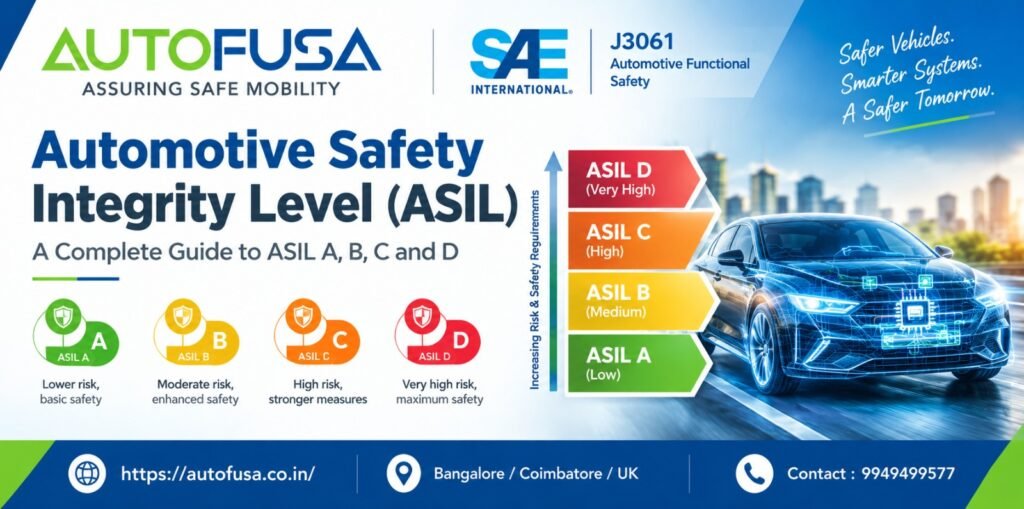
Automotive Safety Integrity Level (ASIL) is a risk classification used in ISO 26262 for safety-related electrical and electronic systems in road vehicles. ASIL has four levels — A, B, C and D — with ASIL D representing the highest safety integrity requirement. ASIL is determined through HARA using Severity, Exposure and Controllability.
Modern vehicles use electronic systems for steering, braking, airbags, powertrain control, driver assistance, and many other functions. When these systems fail, the result can range from a minor inconvenience to a serious accident.
This is why automotive functional safety is an important part of vehicle development. Automotive Safety Integrity Level (ASIL) is one of the key concepts used under ISO 26262 to classify the safety risk of automotive systems.
For companies working on automotive safety integrity level in India, understanding ASIL A, B, C, and D is important for making the right safety decisions during vehicle development.
Contact now for Expert Automotive Safety Providers
Did You Know? 4 — ASIL levels: A, B, C and D |
Automotive Safety Integrity Level in India
ASIL is a risk classification used in ISO 26262 for safety-related electrical and electronic systems in road vehicles.
ASIL helps engineers understand how much attention and rigor a safety-related function requires. The classification is based on three main factors:
- Severity (S) – How serious could the harm be?
- Exposure (E) – How often could the situation occur?
- Controllability (C) – How difficult would it be for people to control the situation?
Based on the HARA results, safety goal may be assigned QM or one of four ASIL levels: A, B, C, or D.
For organizations handling automotive safety integrity level in India, ASIL is not simply a rating given to a complete vehicle or individual component. It is determined based on the safety risk associated with a specific item and hazardous event.
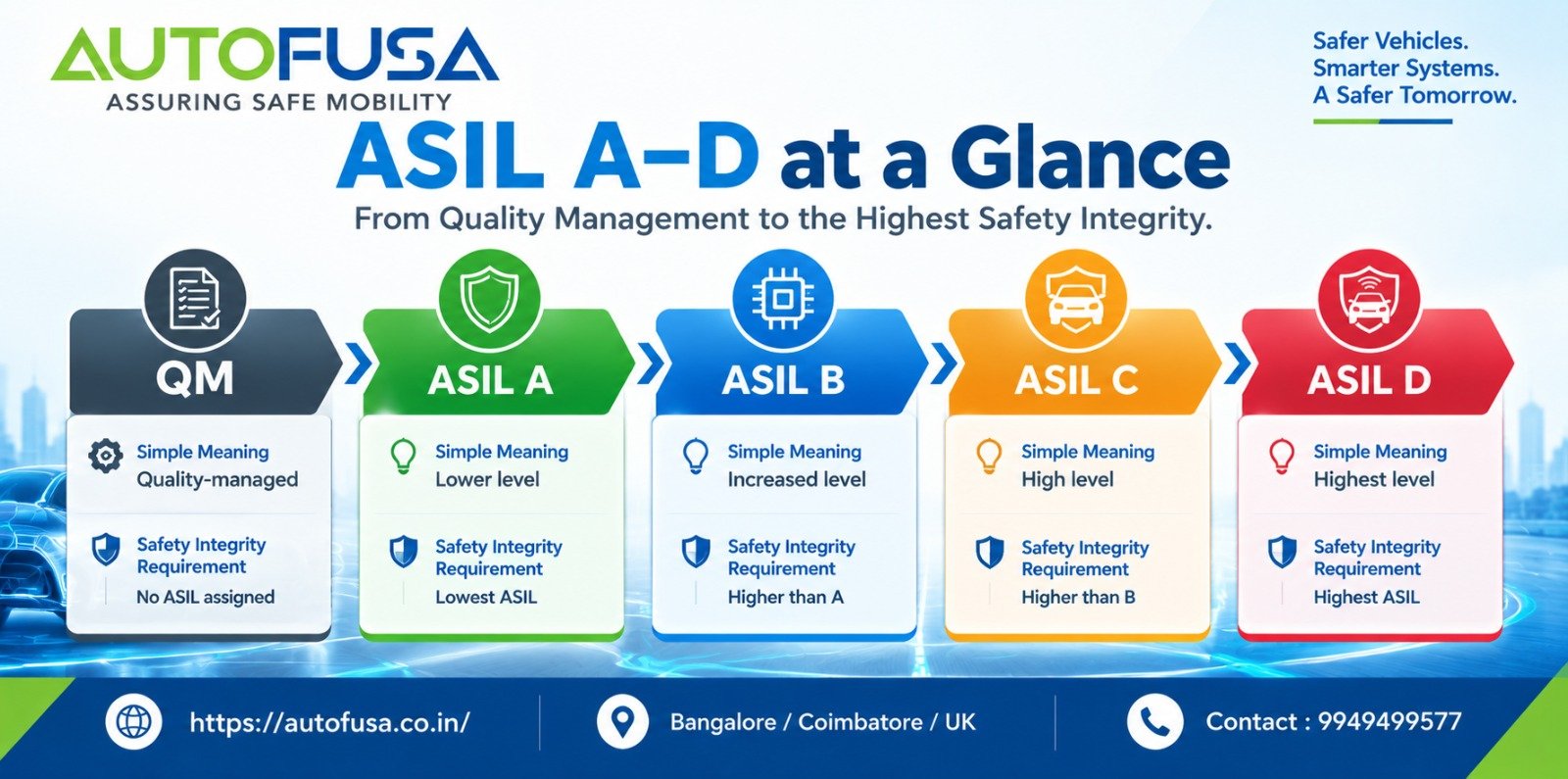
ASIL Levels at a Glance
Level | General meaning |
QM | Managed through quality management requirements |
ASIL A | Lowest ASIL safety integrity requirement |
ASIL B | Higher safety integrity requirement |
ASIL C | High safety integrity requirement |
ASIL D | Highest ASIL safety integrity requirement |
ASIL D does not mean that a system is “100% safe.” It means the applicable safety requirements are at the highest ASIL level defined by ISO 26262.
What Are the Four ASIL Levels?
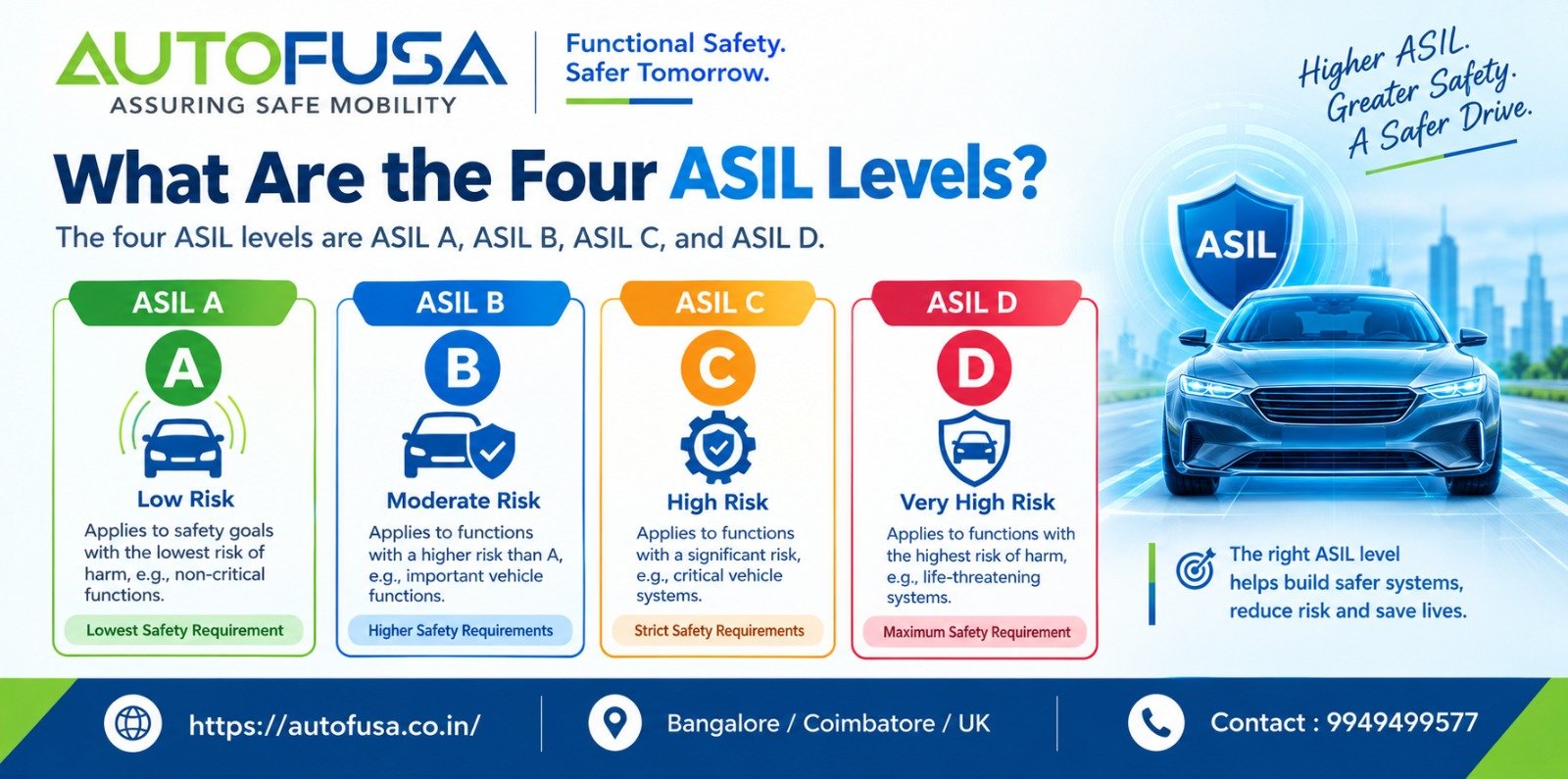
The four ASIL levels are ASIL A, ASIL B, ASIL C, and ASIL D.
The level depends on the outcome of the safety risk assessment. A higher ASIL generally results in more demanding safety activities, depending on the item, architecture, lifecycle phase, and applicable ISO 26262 requirements.
For an automotive safety integrity level in India project, the ASIL level helps teams plan safety requirements, verification, validation, documentation, and supporting evidence.
ASIL A Explained
ASIL A is the lowest of the four ASIL levels.
It applies when the assessed safety risk requires a lower level of safety integrity compared with ASIL B, C, or D. Even though it is the lowest ASIL level, the relevant safety requirements still need to be addressed properly.
Teams should not assume that ASIL A means “no safety work.” The project still needs appropriate analysis, requirements, development activities, verification, and documentation.
ASIL B Explained
ASIL B represents a higher safety integrity requirement than ASIL A.
It may apply to safety-related functions where a failure could create a more significant safety concern. The exact classification depends on the HARA and the specific hazardous event.
For teams working on automotive safety integrity level in India, understanding the difference between ASIL A and ASIL B helps avoid incorrect classification during early safety planning.
ASIL C Explained
ASIL C represents a high safety integrity requirement.
Safety-related functions classified at ASIL C require strong attention to safety requirements, architecture, development, verification, validation, and safety evidence.
ASIL C is not assigned simply because a component is important. The classification must come from the relevant safety analysis and context.
ASIL D Explained
ASIL D is the highest ASIL level in ISO 26262.
It is associated with situations where the assessed risk requires the highest level of safety integrity. Development teams may need to apply rigorous safety processes and provide strong evidence that applicable safety requirements have been addressed.
For organizations working with automotive safety integrity level in India, ASIL D projects require careful planning from the early concept phase through system, hardware, software, production, and supporting safety activities.
How Is ASIL Determined?
ASIL determination starts with the Item Definition and Hazard Analysis and Risk Assessment (HARA).
A simplified process is:
Item Definition → Hazard Identification → Hazardous Events → Severity → Exposure → Controllability → ASIL Determination → Safety Goals
The HARA team identifies potentially hazardous situations and evaluates their safety impact.
What Is HARA in ASIL Determination?
HARA means Hazard Analysis and Risk Assessment.
It is a key activity in the ISO 26262 concept phase. The engineers studies how malfunctioning behavior could create hazards and evaluates the related hazardous events.
For example, imagine an electronic braking-related function. If the function behaves incorrectly, the vehicle may not respond as expected. The engineers would study the driving situation, possible consequences, and whether the driver or another road user could control the situation.
The resulting analysis supports the safety classification.

What Are Severity, Exposure and Controllability?
The three important HARA factors are:
Factor | Meaning | Common scale |
Severity | Possible level of harm | S0–S3 |
Exposure | Frequency of the operational situation | E0–E4 |
Controllability | Ability to control the situation | C0–C3 |
These factors are considered together to determine the applicable ASIL.
A common mistake is to look at only one factor. ASIL determination requires the relevant combination of Severity, Exposure, and Controllability.
How Does HARA Determine ASIL?
HARA evaluates each relevant hazardous event using the S, E, and C classifications.
For example, a hazardous event with serious consequences, frequent exposure, and difficult controllability can result in a higher ASIL classification than an event with lower severity and easier controllability.
This is why automotive safety integrity level in India should be determined through a structured safety analysis instead of using a fixed classification for a component.
What Is the Difference Between ASIL and QM?
QM means Quality Management.
QM is not an ASIL level. It indicates that the safety risk does not require an ASIL classification under the relevant assessment, while applicable quality requirements still apply.
The basic classification can therefore be:
QM → ASIL A → ASIL B → ASIL C → ASIL D
ASIL D represents the highest ASIL safety integrity requirement.
ASIL vs Safety Integrity vs Safety Risk
These terms are related but not identical.
- Safety risk refers to the potential safety concern associated with a hazardous event.
- Safety integrity relates to the ability of a safety-related function to perform as required.
- ASIL provides a classification used to determine the level of safety integrity required.
For automotive safety integrity level in India, keeping these terms separate helps teams communicate clearly with OEMs, suppliers, engineers, and assessors.
Real-World Example of ASIL Determination
Consider an electronic steering function.
A engineers team identifies a possible malfunction that could affect vehicle direction. The engineers then considers:
- What could happen if the malfunction occurs?
- How serious could the result be?
- How frequently could the driving situation occur?
- Can the driver reasonably control the situation?
- What ASIL does the HARA result indicate?
This is only an educational example. The actual ASIL must be determined using the project-specific item definition and HARA.
How ASIL Affects Automotive Development
ASIL can influence several development activities, including:
- Safety requirements
- System architecture
- Hardware development
- Software development
- Verification and validation
- Safety analysis
- Traceability
- Safety documentation
- Functional safety assessment
The exact activities depend on the applicable requirements and project scope.
What Does ASIL Mean for Automotive OEMs and Suppliers?
OEMs and suppliers need a common understanding of the assigned ASIL.
A supplier may receive safety requirements from an OEM and need to show how those requirements are implemented and supported with evidence.
Clear ASIL communication can reduce misunderstandings between vehicle manufacturers, Tier-1 suppliers, software teams, hardware teams, and safety engineers.
For automotive safety integrity level in India, this becomes especially important when Indian engineering teams work with global OEM and supplier programs.
Common ASIL Classification Mistakes
Some common mistakes include:
- Assigning ASIL based only on the component name
- Skipping detailed HARA analysis
- Confusing ASIL with product quality
- Treating ASIL D as “zero risk”
- Using the same ASIL for every project
- Failing to maintain traceability
- Not reviewing safety assumptions after system changes
- Treating functional safety and cybersecurity as the same discipline
A structured process helps reduce these issues.
How AutoFuSa Supports ASIL and ISO 26262 Activities
AutoFuSa provides automotive functional safety consulting and support for organizations working on ISO 26262 projects.
Support can include:
- HARA support
- ASIL determination support
- Safety goals
- Functional safety activities
- ISO 26262 consulting
- Gap assessment
- Safety documentation
- Functional safety training
- Safety case support
- Functional safety assessment support
If your project involves automotive safety integrity level in India, AutoFuSa can help your team understand the applicable safety activities and organize the required work.
AutoFuSa Functional Safety Support
AutoFuSa supports automotive organizations with:
- ISO 26262 consulting
- HARA
- ASIL determination
- Functional safety assessment
- Gap assessment
- Safety documentation
- Safety case support
- Functional safety training
Talk to an AutoFuSa Functional Safety Expert
Automotive Functional Safety Glossary
ASIL: Automotive Safety Integrity Level.
HARA: Hazard Analysis and Risk Assessment.
QM: Quality Management classification.
ASIL A: Lowest ASIL level.
ASIL D: Highest ASIL level.
Safety Goal: High-level safety requirement derived from hazardous-event analysis.
Functional Safety: The part of safety concerned with unreasonable risk arising from malfunctioning behavior of E/E systems.
Frequently Asked Questions
What does ASIL mean in ISO 26262?
ASIL stands for Automotive Safety Integrity Level. It classifies the required level of safety integrity for relevant automotive safety functions.
How many ASIL levels are there?
There are four ASIL levels: A, B, C, and D. ASIL D represents the highest safety integrity requirement.
Is ASIL D the safest level?
ASIL D is the highest ASIL classification, but it does not mean that a vehicle or system has zero safety risk.
How is ASIL determined?
ASIL is determined through safety analysis, mainly using HARA and the factors Severity, Exposure, and Controllability.
Is ASIL assigned to every automotive component?
No. ASIL classification depends on the safety context, item definition, hazardous events, and HARA results.
Why is ASIL important in India?
As Indian automotive companies and engineering teams support global vehicle programs, understanding automotive safety integrity level in India helps teams plan ISO 26262 safety activities and communicate requirements with customers and suppliers.
Key Takeaways
- ASIL is an important concept in ISO 26262.
- There are four ASIL levels: A, B, C, and D.
- ASIL D is the highest ASIL safety integrity requirement.
- HARA supports ASIL determination.
- Severity, Exposure, and Controllability are key HARA factors.
- ASIL is not a general product quality score.
- The correct classification depends on the specific project and hazardous event.
- Strong documentation and traceability are important throughout development.
- Teams working on automotive safety integrity level in India should use a structured, project-specific approach.
Need Help With Automotive Safety Integrity Level Assessment?
Correct ASIL determination is an important part of an ISO 26262 functional safety program. AutoFuSa supports automotive companies, OEMs, suppliers, and engineering teams with HARA, ASIL-related activities, functional safety consulting, assessments, training, and safety documentation.
Talk to AutoFuSa about your ISO 26262 project and ASIL requirements.
Website: autofusa.co.in
Phone: +91 99494 9577

Author – Vijayraj R
Role – Functional Safety Engineer
Organization – AutoFuSa