If you build cars, car parts, car software, or any other on-road or off-road vehicles, one rule can make or break your business: ISO 26262. It is the global safety standard for road vehicles. And getting it right is hard without any help. This is why more companies now hire an ISO 26262 functional safety consultant to work with them
At AutoFuSa, we work with automotive companies every day who are stuck in the process. They know the rule exists. They don’t know how to meet it fast, without wasting money or missing deadlines. This blog breaks it down in plain words.
Not sure if your product falls under ISO 26262?
What Is ISO 26262 and Why Does It Matter?
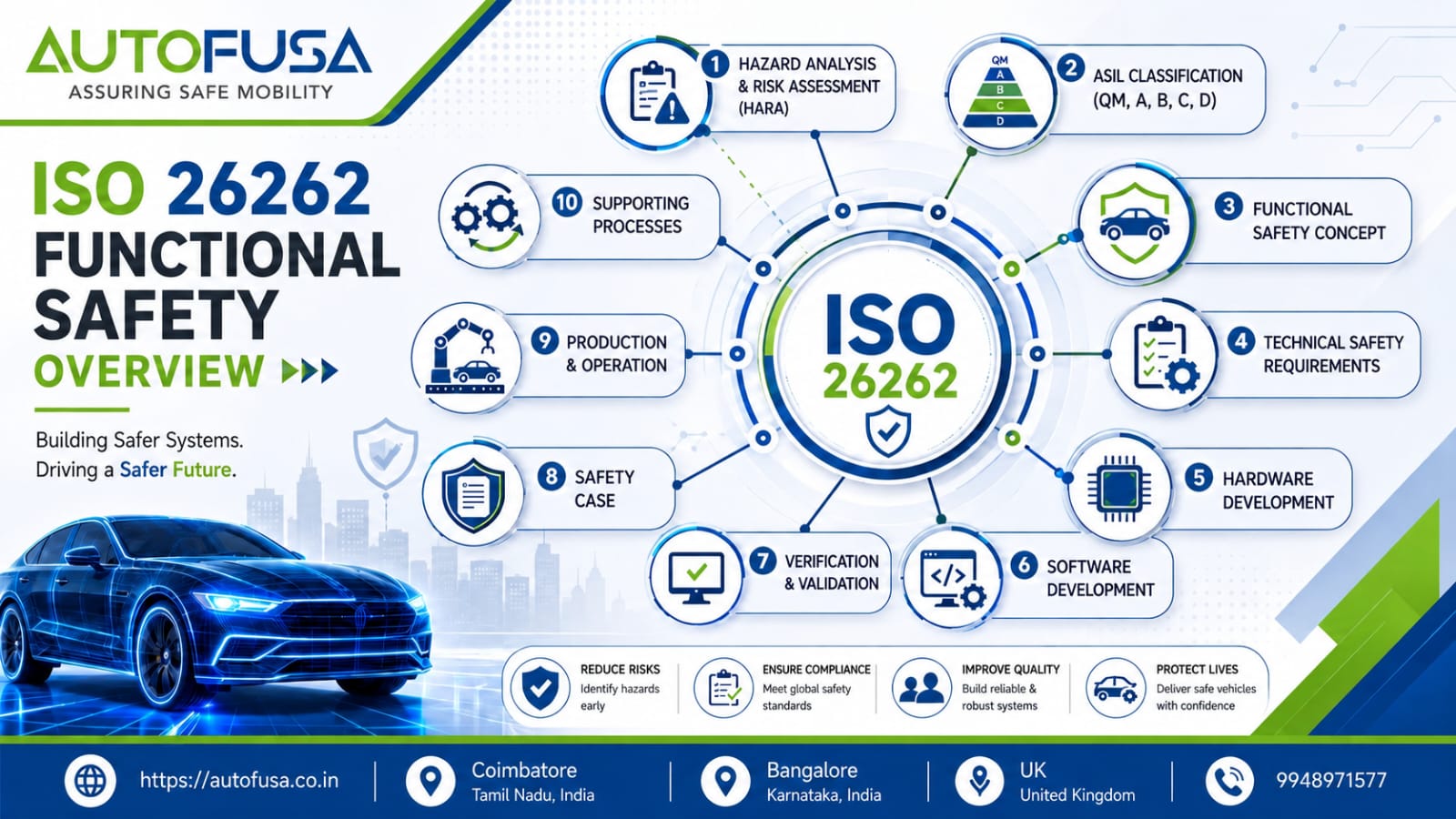
ISO 26262 is the international safety standard for electrical and electronic systems in cars. It was first published in 2011 and updated in 2018. The updated version has 12 parts and now covers trucks, buses, and even motorcycles, not just passenger cars. All automotive vehicles come under this classification
The standard tells you how to design safe systems, how to validate them, and what tests you must run to prove they won’t fail in a way that hurts someone. It applies to OEMs (car makers), Tier 1 and Tier 2 suppliers, and any company building electronic control units, sensors, batteries, or software for vehicles.
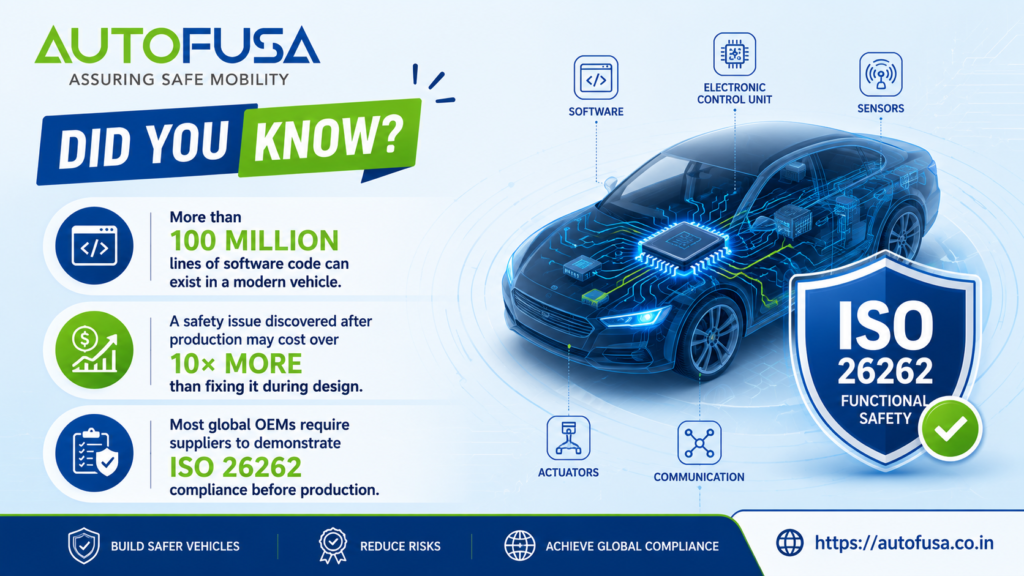
If you skip it, the risks are real: product recalls, lawsuits, and being dropped from OEM supplier lists. Most big car/Automotive vehicle makers will not sign a contract with a supplier who cannot show ISO 26262 proof. This is one reason so many companies bring in an ISO 26262 functional safety consultant early, instead of trying to fix problems after a part is already built.
The Real Cost of Non-Compliance
Skipping ISO 26262, or doing it poorly, costs more than most companies expect.
Financial risk: A single vehicle recall can cost a manufacturer tens of millions of dollars once you add parts, labor, and shipping. Even a small electronic fault, if missed during safety testing, can force a recall of thousands of vehicles.
Reputational risk: Losing trust with an OEM often means losing the contract for good. Car makers keep long supplier lists, and safety failures move you to the bottom fast.
Legal risk: If a crash is linked to a system failure, and your safety case is weak, your company can face direct legal liability. Courts and regulators now expect documented proof of safety work, not just good intentions.
This is exactly the gap an ISO 26262 functional safety consultant is trained to close by building the paperwork, testing, and proof your company needs before problems show up on the road.
7 reasons Automotive Companies Need ISO 26262 Consulting Services
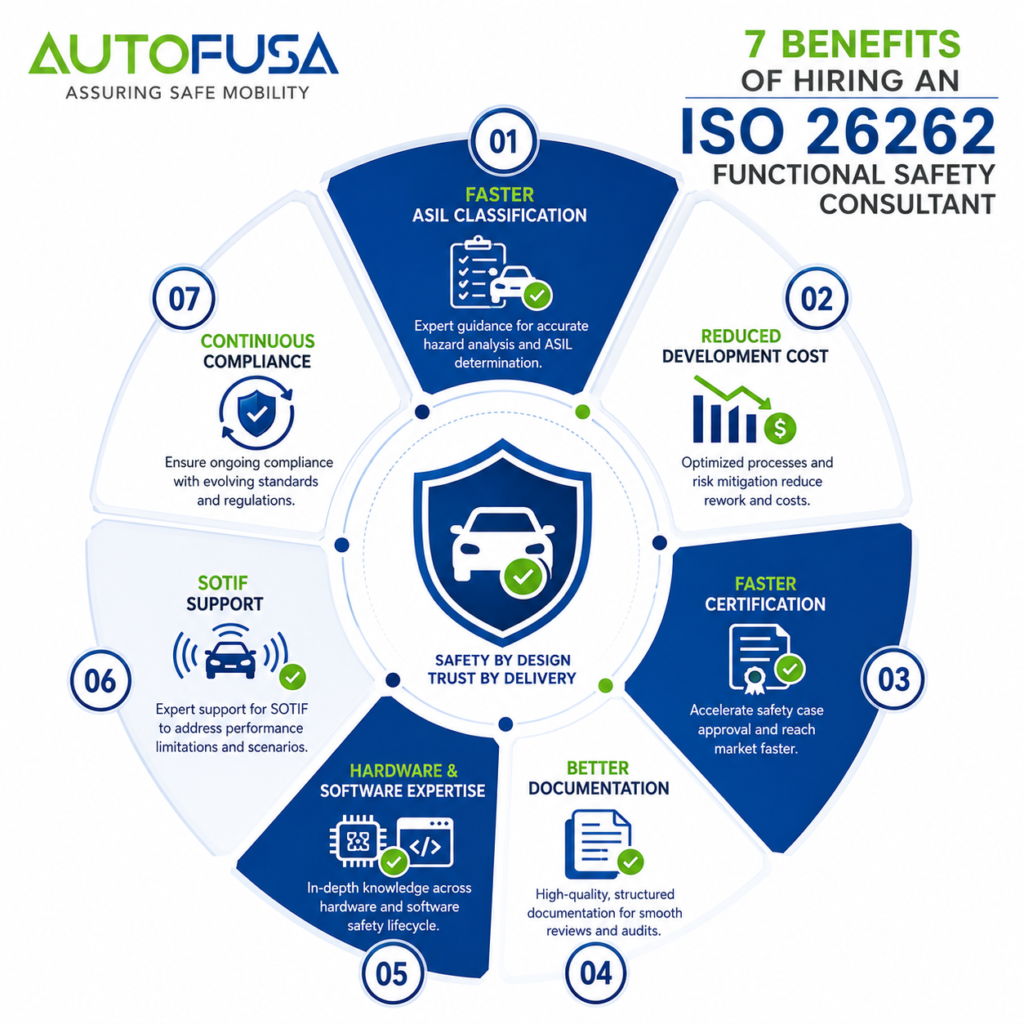
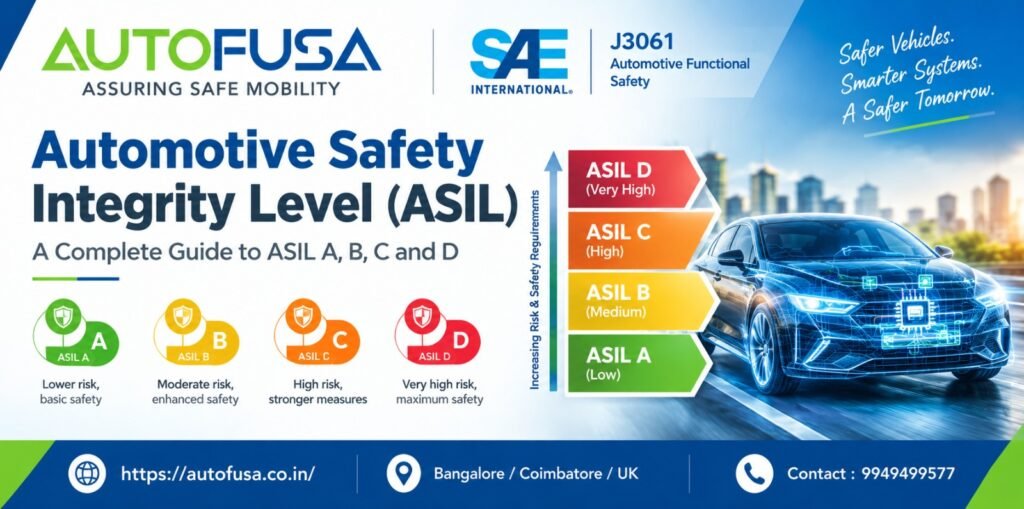
1. Faster ASIL classification. An ASIL (Automotive Safety Integrity Level) rating tells you how critical a part is. A trained ISO 26262 functional safety consultant can classify your systems correctly in weeks, not months.
2. Shorter certification and audit time. Consultants know what auditors check first. This alone can cut audit prep time in half for many suppliers.
3. Less rework. Catching a safety gap during design is cheap. Catching it after production can cost 10 times more, sometimes far higher, once tooling and parts are involved.
4. Safety case documentation done right. This is the paper trail that proves your product is safe. Missing or messy documentation is the top reason audits fail
5. Software and hardware coverage. ISO 26262 Part 4 covers System, Part 5 covers hardware, and Part 6 covers software. Most in-house teams are strong in one area but weak in the other. A consultant covers all phases.
6. The SOTIF support for ADAS and self-driving features. ISO 21448 (SOTIF) works alongside ISO 26262 for advanced driver assistance and autonomous systems. This is a fast-growing need as more cars add these features.
7. Staying current as rules change. EU rules keep adding requirements. A good ISO 26262 functional safety consultant tracks these changes so you don’t have to.
In-House vs. Consulting: Which Is Right for You?
| Factor | In-House Team | ISO 26262 Consulting |
| Cost | High (hiring, training, tools) | Lower, pay for what you need |
| Time to compliance | Months to years | Often weeks to a few months |
| Expertise depth | Grows slowly | Immediate, proven experience |
| Scalability | Hard to scale up or down | Easy to scale per project |
For most small and mid-size automotive suppliers, hiring a consultant costs far less than building a full safety team from scratch.
What to Look for in an ISO 26262 Consulting Partner
● Certified assessors. Look for consultants trained or recognized by bodies like TÜV.
● Real OEM experience. Ask for past projects with car makers or Tier 1 suppliers. Not only for cars, but also for all automotive vehicles
● Tool knowledge. Good consultants know tools like JIRA, DOORS, Polarion, Jama Connect, IQ-RM, Ansys Medini Analyzes, Enco SOX, Cadence MIDAS, and MATLAB well.
● Support after certification. Safety work does not stop once you pass an audit. You need ongoing help as products change.
How AutoFuSa Helps Automotive Companies Achieve ISO 26262 Compliance
AutoFuSa works as your ISO 26262 functional safety consultant from day one. We handle gap analysis, ASIL classification, safety case documents, and full audit preparation. Our team has supported automotive suppliers across ECU design, battery management systems, and ADAS software.
We don’t just hand you a checklist. We sit with your engineers, review your designs, and fix gaps before they become expensive problems.
Our organization has extensive expertise in this field, with experienced professionals available to provide guidance. We assign appropriate subject matter experts for each part of ISO 26262 to deliver focused training, improve understanding, and provide expert-level feedback throughout the learning process.
Frequently Asked Questions
How long does ISO 26262 compliance take?
With an experienced ISO 26262 functional safety consultant, many mid-size projects reach compliance in 3 to 6 months. Doing it alone often takes over a year. An end-to-end project, from system to validation is take up to a year
Is ISO 26262 mandatory for EV makers?
Yes. Any electrical or electronic safety-related system, including EV battery and motor control units, falls under ISO 26262.
What is the difference between ISO 26262 and SOTIF?
ISO 26262 covers system failures. SOTIF (ISO 21448) covers cases where a system works as designed, but still causes an unsafe situation, common in ADAS and self-driving features.
Ready to Get Compliant, Faster?
Waiting costs more than acting. Every month without a clear safety plan is a month closer to a rushed, expensive fix later. We will also help with safety analysis – HARA, FMEA, and FTA, on System, Hardware, and Software phases
We will support and consult for all parts of ISO 26262, like Concept, System, Hardware, Software phases, and supporting process, management activities, ASIL decomposition, as well as POSD activities.
We will also support semiconductors and Motorcycle – Part 11 and 12 as well. Our Organization can provide end-to-end system function support on all the work products of ISO 26262, and we can also help you get a TUV certificate and guide you through the ISO 26262 process
Book a Free ISO 26262 Readiness Assessment with AutoFuSa today. It’s a 15-minute call, no pressure, no obligation. You’ll walk away with a clear roadmap for your product.

 by
by